
2026 Episodes
Episode 01: Confederation
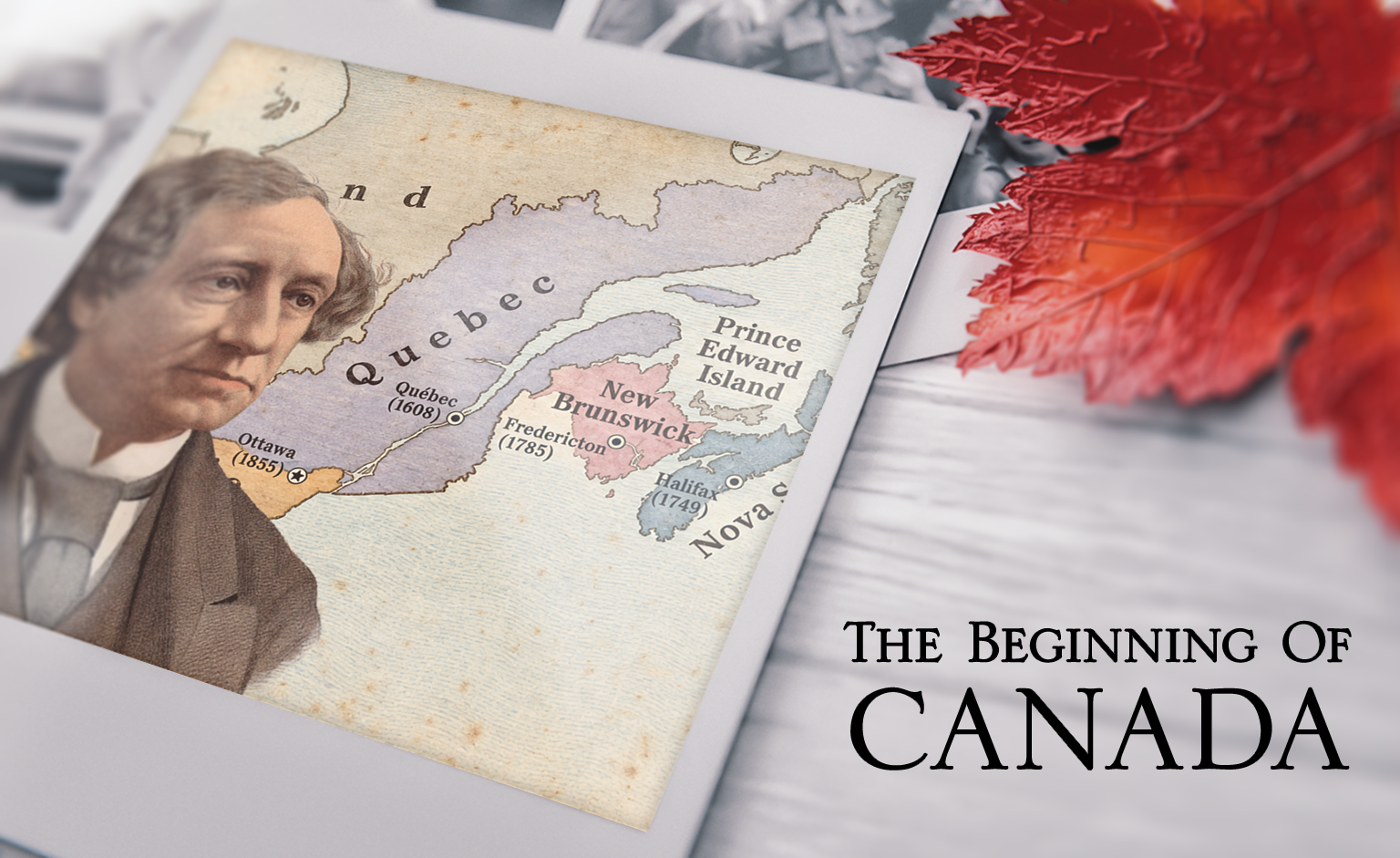
In the first episode of Unveiling Canada, Tanya looks at the real question behind Confederation: not just how Canada became a country, but why it happened at all. From political deadlock and uncertain trade to railway dreams and fears from the south, this episode explores the pressures that pushed separate colonies toward union.
Canada was not inevitable. It had to be built.
Image Sources & Attribution
Composite created for Unveiling Canada. Includes public-domain portrait of John A. Macdonald by William Notman, 1863, via Wikimedia Commons, and custom graphic/map elements created for Unveiling Canada.
Source: View source
Licence: Public Domain Mark 1.0. The John A. Macdonald portrait is listed as public domain on Wikimedia Commons.
Changes: Cropped, composited, colour adjusted, and combined with text/graphic elements.
A New and Correct map of the British Colonies in North America comprehending Eastern Canada with the Province of Quebec, New Brunswick, Nova Scotia, and the Government of Newfoundland with the Adjacent States of New England, Vermont, New York, Pennsylvania and New Jersey, 1794. Creator: Robert Laurie and James Whittle. Source: York University Libraries, Clara Thomas Archives & Special Collections, via Wikimedia Commons.
Source: View source
Licence: Public domain / Creative Commons Public Domain Mark 1.0.
Changes: Cropped for video.
Author: Royal Proclamation. Reproduced in One hundred and twenty Canadian historical pictures, portraits, and documents, Toronto, 1914, via Wikimedia Commons.
Source: View source
Licence: Public domain in Canada and the United States.
Changes: Cropped and colour adjusted for video.
Created for Unveiling Canada.
Licence: Original/custom graphic created for this episode.
Changes: Used as video graphic.
Map data/graphic based on “Canada change 1867-07-01” by Golbez, licensed CC BY-SA 4.0, via Wikimedia Commons.
Source: View underlying map
Author unknown. Publisher: Dawson Bros., Montreal. Source: Newberry Library, Everett D. Graff Collection of Western Americana, via Wikimedia Commons.
Source: View source
Licence: Public domain / Creative Commons Public Domain Mark 1.0.
Changes: Cropped for video.
Author: Albert Gallatin. Source: David Rumsey Collection, via Wikimedia Commons.
Source: View source
Licence: Public domain in Canada and the United States.
Changes: Cropped for video.
Photographer: James Newbury Edy. Source: Library and Archives Canada, MIKAN 3193501, via Wikimedia Commons.
Source: View source
Licence: Public domain in Canada.
Changes: Cropped for video.
Composite created for Unveiling Canada using public-domain portraits from Wikimedia Commons.
Sources: George Brown | George-Étienne Cartier | John A. Macdonald
Licences: Public domain / Public Domain Mark 1.0.
Changes: Cropped, composited, labelled, and converted to a single video graphic.
Printed by D. McLellan, New York. Source: Library and Archives Canada, Alexander E. MacDonald Canadiana Collection #529, via Wikimedia Commons.
Source: View source
Licence: Public domain / free of known copyright restrictions.
Changes: Cropped for video.
International Convention at Quebec of Delegates of the Legislatures of Canada, Nova Scotia, New Brunswick, Prince Edward Island and Newfoundland, October 27, 1864. Photographer: Jules I. Livernois. Source: Library and Archives Canada, MIKAN 3623086, via Wikimedia Commons.
Source: View source
Licence: Public domain in Canada and the United States.
Changes: Cropped for video.
Artist: Charles Walter Simpson. Source: Library and Archives Canada, via Wikimedia Commons.
Source: View source
Licence: Public domain in Canada.
Changes: Cropped for video.
Author: Office of the Chief of Military History, United States Army, American Military History, Army Historical Series, Perry-Castañeda Library Map Collection. Source: Wikimedia Commons.
Source: View source
Licence: Public domain, United States government work / Creative Commons Public Domain Mark 1.0.
Changes: Cropped for video.
Creator: Comparative Synoptical Chart Co., Limited. Published 1897. Source: Library of Congress, Geography and Map Division, via Wikimedia Commons.
Source: View source
Licence: Public domain in the United States.
Changes: Shown in motion with pan/zoom for video.
Map illustrating Canadian and Fenian movements during the Niagara raid on June 2, 1866. Published by W.C. Chewett & Co., Toronto. Source: Wikimedia Commons.
Source: View source
Licence: Public domain.
Changes: Cropped, zoomed, and annotated with red arrows / red X for video.
Lithograph printed by Chas. Hart, 99 Fulton Street, New York. Source: Library of Congress Prints and Photographs Division, via Wikimedia Commons.
Source: View source
Licence: Public domain.
Changes: Cropped and shown in motion with pan/zoom for video.
Source: Wikimedia Commons.
Source: View source
Licence: Public domain.
Changes: Cropped and shown in motion with pan/zoom for video.
Licence noted: Public domain / PD-Canada
Best use: Trade, shipping, and port activity visual.
Licence noted: Public domain / PD-Canada
Best use: Alternate harbour/trade visual.
Source: Wentworth-Westchester Historical Group photo collection, via Wikimedia Commons.
Source: View source
Licence: Public domain.
Changes: Cropped and shown in motion with pan/zoom for video.
Creator: Sir Sandford Fleming. Made under instruction from the Canadian Government. Source: Library and Archives Canada.
Source: View source
Licence: Public domain / archival government map.
Changes: Cropped for video.
Creator of original map: Sir Sandford Fleming. Made under instruction from the Canadian Government. Source: Library and Archives Canada. Red route overlay created for Unveiling Canada.
Source: View original map
Licence: Original map is public domain / archival government map. Red route overlay created for this episode.
Changes: Proposed railway route highlighted in red for video.
Source: Wikimedia Commons.
Source: View source
Licence: Public domain.
Changes: Cropped and shown in motion with pan/zoom for video.
Convention at Charlottetown, Prince Edward Island, of delegates from the legislatures of Canada, New Brunswick, Nova Scotia, and Prince Edward Island, September 1, 1864. Source: Wikimedia Commons.
Source: View source
Licence: Public domain / Public Domain Mark 1.0.
Changes: Cropped and shown in motion with pan/zoom for video.
Robert Harris painting, Conference at Québec in 1864, to settle the basics of a union of the British North American Provinces. Source: Library and Archives Canada, via Wikimedia Commons.
Source: View source
Licence: Public domain / PD-Canada.
Changes: Cropped and shown in motion with pan/zoom for video.
Commemorative composite showing delegates of the Quebec Conference, published and copyrighted by C.J. Hall, Ottawa, 1917. Source: Library and Archives Canada, via Wikimedia Commons.
Source: View source
Licence: Public domain / PD-Canada.
Changes: Cropped and shown in motion with pan/zoom for video.
Original Centre Block of the Parliament Buildings in Ottawa, before the 1916 fire. Source: Library and Archives Canada, via Wikimedia Commons.
Source: View source
Licence: Public domain / PD-Canada.
Changes: Cropped and shown in motion with pan/zoom for video.
Map showing the formation of the Dominion of Canada on July 1, 1867. Creator: Golbez. Source: Wikimedia Commons.
Source: View source
Licence: CC BY-SA 4.0.
Changes: Cropped and shown in motion with pan/zoom for video.
Seating diagram for the Canadian House of Commons after the 1867 election. Data taken from the Library of Parliament. Image generated with Parliament Diagram Tool. Author: Mr Serjeant Buzfuz. Source: Wikimedia Commons.
Source: View source
Licence: CC0 1.0 Universal Public Domain Dedication.
Changes: Adapted into a custom Unveiling Canada graphic, cropped, colour adjusted, labelled, and used in video.
Episode 02: Dawson City Film Find
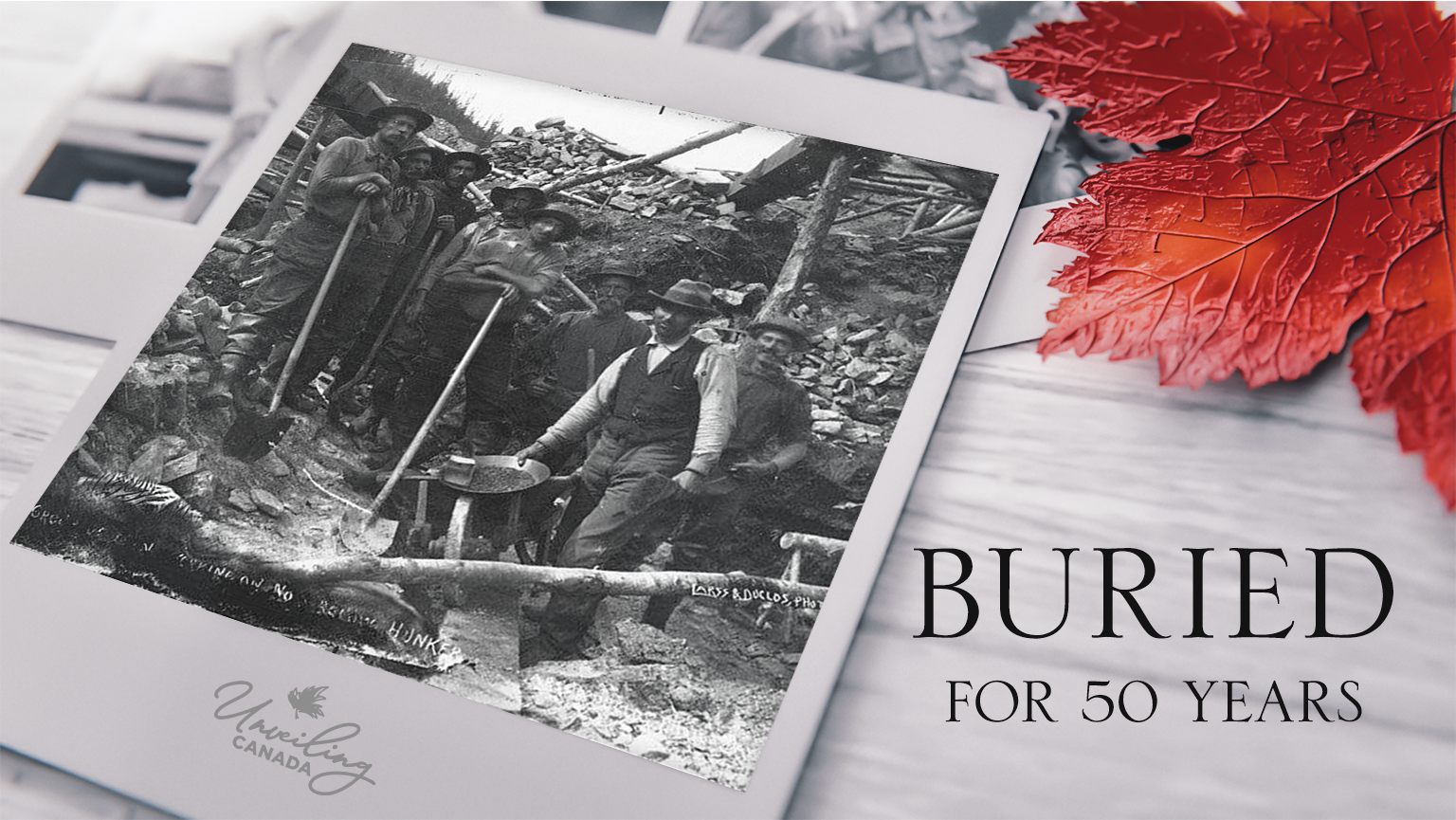
In 1978, a backhoe digging at a construction site in Dawson City uncovered hundreds of silent-film reels buried beneath an old swimming pool and hockey rink. Many contained the last surviving copies of movies once believed lost, preserved for nearly fifty years by the Yukon permafrost. In this episode of Unveiling Canada, Tanya explores how the films ended up there and how an accidental discovery brought a forgotten chapter of cinema history back to life.
Image Sources & Attribution
Group of gold miners along Hunker Creek near Dawson, Yukon Territory, circa 1900
Photograph by Larss & Duclos Studio. University of Washington Libraries, Special Collections, accession AL+CA 2722.
Source: Wikimedia Commons
Licence: Public domain
Changes: Cropped, rotated and incorporated into the thumbnail design with programme branding and title text.
The Girl of the Northern Woods (1910)
Directed by Barry O'Neil and produced by the Thanhouser Company. Digitized copy made available through Wikimedia Commons.
Source: Wikimedia Commons
Licence: Public domain
Changes: Brief excerpts used in the introduction and later in the episode; cropped to the programme aspect ratio and presented beneath narration without the source audio.
The Social Buccaneer (1916), featuring Louise Lovely
Still from a film recovered in the Dawson City Film Find. Courtesy of the Dawson City Museum, Library and Archives Canada, and the Library of Congress. The reproduced still was published with a photograph credit to Kathy Jones-Gates and the Dawson City Archives.
Source: Vanity Fair
Licence: The underlying 1916 film is public domain. No open licence was identified for this particular reproduction.
Changes: Cropped and resized for display beside the presenter.
Negroes' Protest: A Silent Parade (1917)
Newsreel footage recovered in the Dawson City Film Find. Courtesy of the Dawson City Museum, Library and Archives Canada, the Library of Congress, and Dawson City: Frozen Time.
Source: Wikimedia Commons, frame 1 and Wikimedia Commons, frame 4
Licence: Public domain
Changes: Brief moving-image excerpt used; cropped to the programme aspect ratio.
For the Papoose (1912)
Produced by Pathé Frères. Preserved as part of the Public Archives of Canada/Dawson City Collection.
Source: Library of Congress filmography
Licence: Public domain
Changes: Brief excerpts used; cropped to the programme aspect ratio and presented beneath narration.
Polly of the Circus (1917)
Directed by Edwin L. Hollywood and Charles Horan; produced by Goldwyn Pictures. A surviving print was recovered in the Dawson City Film Find.
Source: Progressive Silent Film List
Licence: Public domain in the United States
Changes: Brief excerpt used; cropped to the programme aspect ratio and presented beneath narration.
1919 World Series newsreel footage
Rare footage of the Chicago White Sox and Cincinnati Reds, recovered in the Dawson City Film Find and preserved by Library and Archives Canada and the Library of Congress.
Source: CBC News background article
Licence: The 1919 source footage is public domain. The exact digital file used in the episode must still be confirmed by the editor.
Changes: Two brief excerpts used; cropped to the programme aspect ratio and presented beneath narration.
First Avenue and Second Street in Dawson City, circa 1899
Photograph by Arthur C. Pillsbury, Pillsbury & Cleveland. Seattle Public Library collection, made available through the Digital Public Library of America.
Source: Wikimedia Commons
Licence: Public domain
Changes: Cropped to fit the frame and shown with a dynamic zoom.
Dawson's Natatorium under construction
Historical photograph from the Canadian Museum of History, Photographic Archives, accession J6050.
Source: Wikimedia Commons
Licence: CC BY-SA 4.0
Changes: Cropped to fit the frame and shown with a dynamic zoom out.
Old-style curling stone
Photograph by Rosser1954.
Source: Wikimedia Commons
Licence: Public domain worldwide
Changes: Cropped to fit the frame and shown with a dynamic zoom out.
Moosehide village
Historical photograph of Moosehide village near Dawson City.
Source: Wikimedia Commons
Licence: Public domain
Changes: Cropped to fit the frame and shown with a dynamic zoom in.
Canadian Bank of Commerce and government commissioner's office, Dawson, 1898
Historical photograph from the Larss and Duclos collection.
Source: Wikimedia Commons
Licence: Public domain
Changes: Cropped, resized and used as one element of a four-image composite displayed around the presenter.
Boys in front of a movie theatre on Dundas Street, Toronto, 1923
Photograph by John Boyd. Library and Archives Canada, PA-086228.
Source: Wikimedia Commons
Licence: Public domain in Canada and the United States
Changes: Cropped to fit the frame and shown with a dynamic zoom in. Used as contextual Canadian moviegoing imagery, not as a photograph of Dawson City.
Steamship Islander leaving Vancouver for Skagway Bay
Historical photograph made available through Wikimedia Commons.
Source: Wikimedia Commons
Licence: Public domain
Changes: Cropped to fit the frame and shown with a dynamic zoom in.
Delivery wagon in front of the Klondike Brewery, Klondike City
Historical photograph from the Canadian Museum of History, Photographic Archives, accession J6101.
Source: Wikimedia Commons
Licence: CC BY-SA 4.0
Changes: Cropped to fit the frame and shown with a dynamic zoom out.
Arrival of the steamboat Monarch at Dawson, July 21, 1898
Photograph by Eric A. Hegg. University of Washington Libraries, Special Collections.
Source: Wikimedia Commons
Licence: Public domain
Changes: Cropped to fit the frame and shown with a downward pan.
Men in a wagon in front of the commissioner's house, Dawson, circa 1900
Photograph by Larss & Duclos. Canadian Museum of History, Photographic Archives, accession J6226.
Source: Wikimedia Commons
Licence: CC BY-SA 4.0
Changes: Source image was already cropped on Commons; further cropped to the programme frame and panned from right to left.
Man with bagpipes outside the Dawson Amateur Athletic Association building
Historical photograph from the Larss and Duclos collection.
Source: Wikimedia Commons
Licence: Public domain
Changes: Cropped and resized for display beside the presenter.
Renzoni and Regina hockey teams outside the Dawson Amateur Athletic Association building
Photograph by Joseph E. N. Duclos. Library and Archives Canada.
Source: Wikimedia Commons
Licence: Public domain
Changes: Cropped and resized for display beside the presenter.
Boys playing ice hockey in Dawson, circa 1900
Historical photograph from the University of Washington Libraries, Special Collections.
Source: Wikimedia Commons
Licence: Public domain
Changes: Cropped to fit the frame and shown with a dynamic zoom in.
Dawson in winter, known as "Dawson at 60 below"
Historical photograph from the Larss and Duclos collection.
Source: Wikimedia Commons
Licence: Public domain
Changes: Cropped and resized for display beside the presenter.
Soup kitchen at 427 in Montreal during the Great Depression, circa 1929
Archival photograph credited to La Presse.
Source: Wikimedia Commons
Licence: Public domain in Canada
Changes: Cropped to fit the programme aspect ratio.
A family watching television, 1958
United States National Archives and Records Administration.
Source: Wikimedia Commons
Licence: Public domain, United States federal government work
Changes: Cropped to fit the frame and shown with a dynamic zoom in.
Ektachrome and Bell & Howell film-reel canisters
Photograph by Christian from Somerville.
Source: Wikimedia Commons
Licence: CC BY-SA 2.0
Changes: Cropped and resized for display beside the presenter.
Two 35 mm film reels in boxes
Photograph by Runner1616.
Source: Wikimedia Commons
Licence: CC BY-SA 3.0
Changes: Cropped to fit the frame and shown with a dynamic zoom in.
Decomposing nitrate film
Library of Congress.
Source: Wikimedia Commons
Licence: CC BY 3.0
Changes: Cropped to fit the frame and shown with a dynamic zoom in.
Employees watching the United States National Archives film-vault fire, December 1978
United States National Archives and Records Administration.
Source: Wikimedia Commons
Licence: Public domain, United States federal government work
Changes: Cropped to fit the frame and shown with a dynamic zoom in. A shortened source credit also appeared on screen.
United States National Archives film-vault fire, Building A, December 1978
United States National Archives and Records Administration.
Source: Wikimedia Commons
Licence: Public domain, United States federal government work
Changes: Cropped to fit the frame and shown with a dynamic zoom out. A shortened source credit also appeared on screen.
Inspecting a film reel
Photograph by Evan.
Source: Wikimedia Commons
Licence: CC BY-SA 2.0
Changes: Cropped and resized for display beside the presenter.
Nitrate film restoration
Photograph by Erwin Verbruggen.
Source: Wikimedia Commons
Licence: CC BY-SA 2.0
Changes: Cropped to fit the frame and shown with a dynamic zoom in.
Boxes of film reels from the Dawson City recovery site, 1978
Photograph by Kathy Jones-Gates. Dawson City Archives.
Source: Vanity Fair
Licence: Copyright Kathy Jones-Gates / Dawson City Archives. No open licence identified.
Changes: Cropped to fit the frame and shown with a dynamic zoom out. Used briefly for documentary commentary and education under a Canadian fair-dealing rationale.
Sam Kula inspecting the demolition site of the old skating rink, 1978
Photograph by Kathy Jones-Gates.
Source: The British Columbia Review
Licence: Copyright Kathy Jones-Gates. No open licence identified.
Changes: Cropped and resized for display beside the presenter. Used briefly for documentary commentary and education under a Canadian fair-dealing rationale.
Sam Kula and Michael Gates examining recovered film reels, 1978
Photograph by Kathy Jones-Gates. Dawson City Archives.
Source: Vanity Fair
Licence: Copyright Kathy Jones-Gates / Dawson City Archives. No open licence identified.
Changes: Cropped to fit the frame; identifying names added over the image. Used briefly for documentary commentary and education under a Canadian fair-dealing rationale.
Kathy Jones-Gates with film salvaged from the former swimming-pool site, 1978
Photograph from the Kathy Jones-Gates collection. Dawson City Archives.
Source: Vanity Fair
Licence: Copyright Kathy Jones-Gates / Dawson City Archives. No open licence identified.
Changes: Cropped and resized for display beside the presenter; an identifying name was added on screen. Used briefly for documentary commentary and education under a Canadian fair-dealing rationale.
Canadian tanks moving into position near Falaise, August 8, 1944
Photograph by Harold G. Aikman, Department of National Defence. Library and Archives Canada, PA-132904.
Source: Wikimedia Commons
Licence: Public domain in Canada
Changes: This credit applies only if the Commons still photograph was used. The editor's catalogue describes moving footage, whose source must be confirmed separately.
Dawson City: Frozen Time (2016)
Written, directed and edited by Bill Morrison. Produced by Bill Morrison and Madeleine Molyneaux; Hypnotic Pictures and Picture Palace Pictures. Distributed by Kino Lorber.
Source: Kino Lorber
Licence: Copyrighted motion picture. No open licence identified.
Changes: Brief excerpts and a promotional/title image were used, including damaged-film examples and historical sequences. Material was cropped to the programme aspect ratio and presented beneath original narration for documentary commentary and education under a Canadian fair-dealing rationale.
Fair dealing is a legal assessment based on context. Attribution does not by itself create permission or guarantee that a use qualifies.